Really Knows AI · Focus Area
AI Agents
Autonomous digital workers that plan, decide, execute, and begin replacing human workflows.
Section 01
Digital Workers Replacing Routine Office Tasks.
Digital workers will first replace the routine office tasks that repeat every day: writing basic emails, scheduling meetings, updating records, preparing reports, answering common questions, organizing files, summarizing documents, and moving information from one system to another. These jobs may not disappear all at once, but the amount of human time needed to do them will shrink. A task that once took an employee two hours may take an AI agent two minutes.
The negative impact is not hard to understand. If one person using AI can do the work that used to require three people, the company will eventually ask why it still needs all three workers. At first, the company may call it productivity. Then it may stop hiring. Then it may cut contractors. Then it may combine roles. Over time, fewer people will be needed to keep the same office running.
This is how AI agents can quietly damage the labor market. The office may still look normal from the outside. Emails still go out. Reports still get finished. Customers still receive answers. But behind the scenes, fewer workers are earning paychecks, fewer entry-level jobs are being created, and fewer young people are getting the chance to learn basic office skills. The work remains, but the worker begins to disappear.
Section 02
Autonomous Workflows That Operate With Less Human Supervision
In insurance claims, the job risk is already visible. The United States has hundreds of thousands of workers whose job is to review claims, inspect evidence, evaluate coverage, estimate loss, detect fraud, and communicate decisions. If AI agents can read the policy, review the documents, analyze photos, estimate damage, flag fraud risk, draft the decision, and update the claim file, the company does not need as many people touching every claim. Some adjusters will still be needed for complex, disputed, or high-value cases, but a large share of routine claims work can be compressed into an automated workflow.
The official job-loss number may start small, but the deeper risk is bigger than a single projection. If AI handles the easier claims first, insurers can reduce hiring, assign more claims to fewer workers, and reserve human adjusters for exceptions. That means the work does not disappear from the insurance company. The claim still gets processed. The customer still receives an answer. But fewer people are needed behind the system, and the entry-level path into claims work becomes narrower.
Healthcare administration may face an even larger version of the same problem. The United States has more than a million workers connected to medical scheduling, patient intake, insurance verification, medical records, coding, forms, chart updates, reminders, follow-up instructions, and health information systems. These are exactly the kinds of repeated information tasks that AI agents are built to absorb. A patient may still see a doctor or nurse, but much of the administrative work around that visit can move through software before a human worker ever touches the file.
The danger is not that hospitals and clinics stop needing people. The danger is that they need fewer people for each patient interaction. If an AI agent can check insurance, collect forms, summarize symptoms, prepare notes, update records, send reminders, and deliver follow-up instructions, then one administrative worker may supervise the work that used to require several staff members. That could mean hundreds of thousands of healthcare administrative jobs are not necessarily eliminated overnight, but slowly reduced through fewer hires, smaller teams, and fewer entry-level openings.
This is the real meaning of autonomous workflows. The system still works. The claim is processed. The appointment is scheduled. The chart is updated. The patient receives instructions. But the human labor underneath the process begins to thin. AI does not need to replace every worker to change the labor market. It only needs to reduce how many workers are needed to move the same amount of work through the system.
Section 03 · Warning
The Risk Of Humans Losing Control Over Decisions They No Longer Personally Make
The most dangerous AI agents may not be the ones that write emails, schedule meetings, or summarize documents. The most dangerous agents may be the ones that quietly decide who deserves attention, who looks suspicious, who gets denied, who gets investigated, and who becomes the target of government or corporate action. Once AI agents move from helping people do work to shaping decisions about people's lives, the risk becomes much larger than job loss.
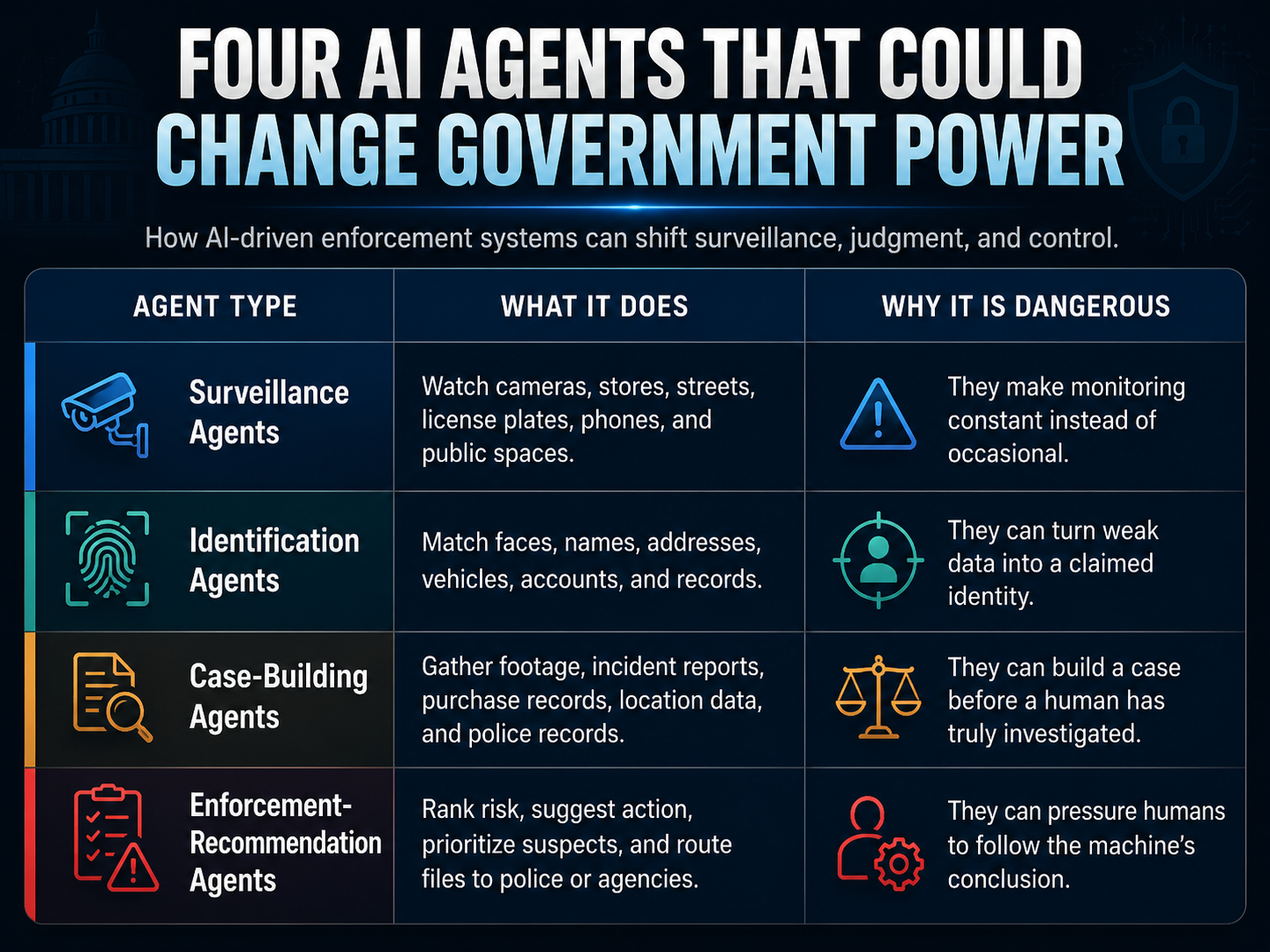
Government enforcement is one of the clearest warning signs. A police department could use AI agents to sort through store security footage, match faces against retail databases, compare images with past incident reports, connect names to addresses, build suspect files, and recommend who should be questioned or arrested. The officer may still make the final move, but the decision path may already have been built by machines before any human being truly investigates the case.
That is the real danger: humans may still appear to be in charge while AI agents quietly build the facts, rank the risk, shape the conclusion, and narrow the choices. A mistake can begin as a blurry image, a bad match, an incomplete database, or a weak assumption. But once the machine turns that mistake into a case file, people may start treating the machine's conclusion as truth. When that happens, society does not simply automate work. It automates judgment.
 reallyknowsnetwork.com
The warning is simple: when AI agents begin making decisions no human fully understands, reviews, or owns, society does not just lose jobs. It loses accountability. The officer says the system flagged the person. The company says the database made the match. The agency says the software followed the policy. The vendor says the model only made a recommendation. Responsibility gets spread across the system until no one fully owns the harm.
Stay ahead of the AI agent shift.
Join the Really Knows Network for ongoing analysis on AI agents, labor, and power.
Join the Network